Understanding I sound words in English phonics is incredibly important for reading and correct pronunciation. However, since not every word follows a single simple rule, we have divided the data into three main parts to make learning easier: Short I, Long I, and Other Special I sounds.
In this article, we will look at all the words through their families and patterns. But before we begin, it is essential to keep these 3 points in mind:
First of all, not every ending is a word family. We only consider base patterns as actual families, while some other endings are simply different grammatical forms of a word. Secondly, exceptions are very common in English, which is why some families overlap and can produce different sounds or meanings.
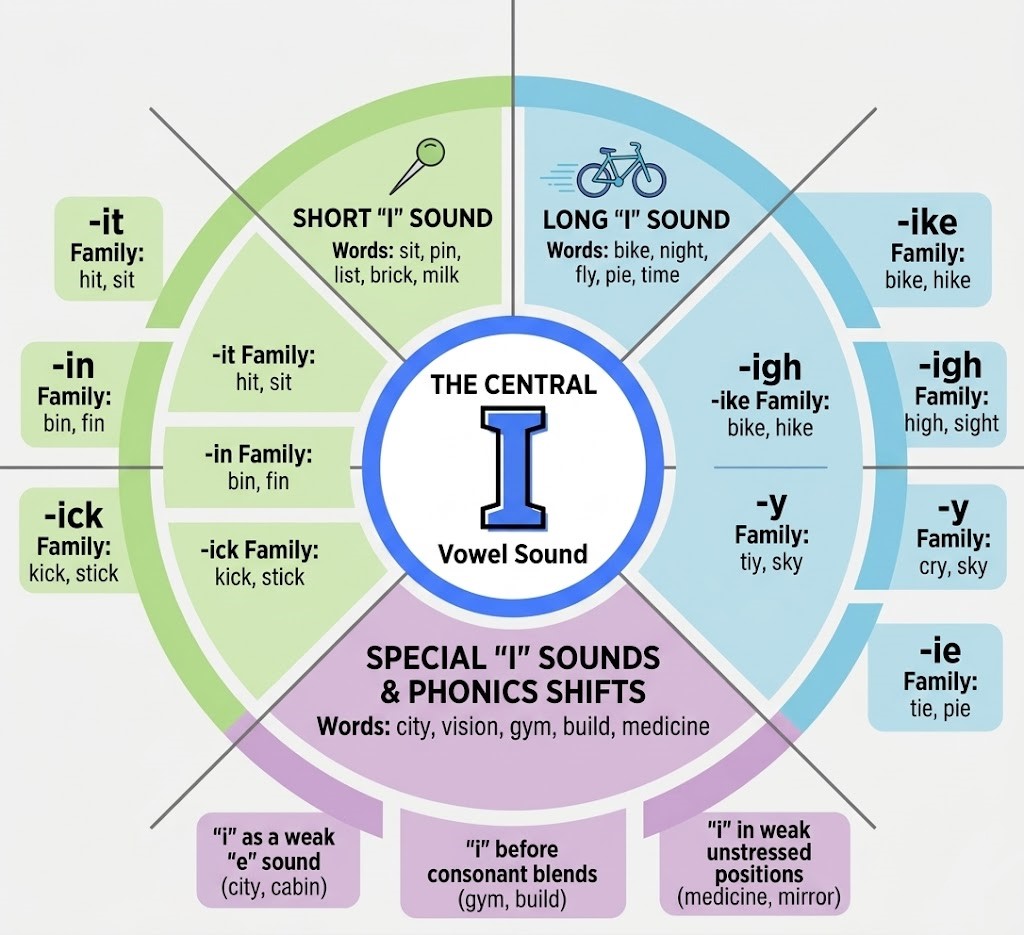
The third and most important point is that Long I has a few main patterns that are very easy to recognize—such as i-e (bike), igh (light), y (cry), and ie (pie). Lastly, for the sake of children’s clarity, Short I and Long I should never be mixed; it is always better to keep them separate.
So, let’s head over to the interactive list below, click on the buttons, and listen to the perfect audio sound of each word!

Related posts:
850 D Sound Words (Shrt & Lng) with Audio Pronunciation
600+ C Sound Words & Phonic List with Audio
1300 Short & Long N Sound Words with Sound Phonics
1100 B Sound Words (Short & Long) with Phonic Sounds to Learn
Learn Short and Long “M” Sound Words with Audio Pronunciation
900+ Short & Long A Sound Words With Audio Practice
1000 All i Sound Words With Audio For Free
800+ All O Sound Words With Audio For Free
1. Short I Sound Words
2. Long I Sound Words
3. Other / Special I Sound Words
FAQs:
1. What is the difference between short ‘i’ and long ‘i’ sounds for early readers?
Answer:
- Short ‘i’ sound (
/ɪ/): Made with a relaxed mouth and quick breath (like in sit, pin, pig, and dig). - Long ‘i’ sound (
/aɪ/): The letter says its actual name “Eye” with a wider mouth movement (like in kite, pie, night, and bike).
2. Why do kids confuse the short ‘i’ sound with short ‘e’? How can parents fix it?
Answer: Kids often confuse short ‘i’ (/ɪ/ as in pin) and short ‘e’ (/ɛ/ as in pen) because the mouth shapes are very similar.
- Fix: Teach kids to look in a mirror—when saying short ‘i’, the chin barely drops and teeth are close together; when saying short ‘e’, the mouth opens wider and chin drops lower.
3. What are the 5 main spelling patterns that make the long ‘i’ sound?
Answer: The long ‘i’ sound can be spelled in 5 common ways:
- i_e (Magic E): Kite, time, line, ride
- igh (Trigraph): Night, light, high, bright
- y (at the end of short words): Fly, sky, dry, my
- ie (Vowel Team): Pie, tie, lie
- i (Open Syllable): Find, kind, wild
4. What are the best 3-letter short ‘i’ (CVC) words to start teaching phonics?
Answer: Beginner-friendly short ‘i’ CVC words grouped by word families:
- -in family: Pin, bin, win, fin, tin
- -it family: Sit, pit, hit, fit, kit
- -ig family: Pig, dig, fig, big, wig
- -ip family: Lip, sip, tip, dip, zip
5. How does the ‘Y’ rule work for the long ‘i’ sound?
Answer: When the letter ‘y’ comes at the end of a single-syllable word (one vowel sound) without any other vowels, it acts as a vowel and makes the long ‘i’ sound (e.g., cry, dry, fly, spy, my).
6. What is the ‘igh’ trigraph, and when should kids learn it?
Answer: A trigraph is a combination of three letters making one single sound. The ‘igh’ pattern makes a clear long ‘i’ sound (e.g., night, sight, flight). Kids usually learn this right after mastering basic CVC words and Magic E rules (around 1st Grade).
7. What happens when ‘i’ is followed by ‘r’ (Bossy R rule)?
Answer: When the letter ‘i’ is followed by ‘r’, it loses its normal short/long sound and forms the /ɜːr/ sound (like in bird, girl, shirt, dirt, and sir).
8. What are some fun hands-on games to practice short ‘i’ sound words at home?
Answer:
- Sound Search Game: Find real household objects that have the short ‘i’ sound (e.g., bin, lid, zip, pin).
- Word Building Blocks: Use plastic blocks to swap the first letter of -it words (change s-i-t to h-i-t).
- Action Blending: Say the individual sounds
/p/ - /ɪ/ - /ɡ/slowly while hopping, then blend and shout “PIG!”.
9. Which common sight words use the short and long ‘i’ sounds?
Answer:
- Short ‘i’ Sight Words: Is, in, it, him, his, if, big, did.
- Long ‘i’ Sight Words: I, my, like, ride, time, find.
10. Why is the letter ‘i’ considered one of the easiest vowels to start CVC blending?
Answer: Short ‘i’ words use very distinct lip position and clear crisp sounds (e.g., sit, pin), making it easier for toddlers to blend consonant-vowel-consonant sounds together compared to trickier vowels like ‘e’ or ‘u’.